Event‑Driven Architecture vs REST: When to Switch
Migrate a high‑volume, low‑latency workflow to an event broker like Kafka to reduce coupling and improve scalability.
Get 5 things to act on each day — instead of 1,500 articles to read. Free, Builder, or Pro.
Migrate a high‑volume, low‑latency workflow to an event broker like Kafka to reduce coupling and improve scalability.
Run /product-init "your product idea" in Claude Code to enforce 9 product gates before any code is generated.
Granite 4.1 offers 3B/8B/30B dense decoder‑only models trained on 15 T tokens with 512K context; fine‑tune with 4.1 M curated samples and apply multi‑stage GRPO+DAPO RL.
Add the Agent Skills slash commands to your Claude Code environment to enforce spec, test, review workflows.
Add DepScope MCP server to your agent config and run check_package to validate dependencies and detect hallucinations.
Implement a MonitoredAgent wrapper around the OpenAI SDK to capture agent state, tool calls, token usage, and latency for production observability.
Check your contact‑centre AI pipeline for latency and naturalness trade‑offs when adding real‑time voice conversion.
Consider leveraging Bedrock Managed Agents on AWS for your clients.
Benchmark K2.6 against your own coding tasks; if it meets Tier A criteria, consider it a viable alternative to commercial models, but also invest in fixing llama.cpp bugs and improving tool‑call parsers to avoid toolchain bottlenecks.
Patch: migrate chatbot API from Flask to FastAPI 0.115 and stream LLM tokens via StreamingResponse to cut latency by 30%.
Patch the extraction prompt to include column descriptions for higher accuracy.
Send a POST /api/render with templateName and data to receive a PDF URL from Templar, eliminating the need for Puppeteer, custom templates, and storage setup.
Learn that OpenAI released MRC, a new protocol that spreads transfers across hundreds of paths, uses SRv6 static source routing, and eliminates BGP, enabling microsecond failure recovery on 800 Gb/s interfaces.
Deploy the GTM agent by connecting Salesforce, Gong, LinkedIn, and Slack to Deep Agents and configuring LangSmith for telemetry.
Implement self‑describing tool responses with status, is_complete, and next_action_hint fields so the agent can detect completion and avoid silent loops.
Use the Gemma 4 MTP draft models to achieve up to 2x decoding speed with identical quality in speculative decoding pipelines.
Install ProgramBench via pip and run eval on your agent to benchmark its ability to rebuild executables from scratch.
Test MTP support in llama.cpp on your GPU; expect 60‑80 tokens/s versus 40 without MTP.
Patch your data pipelines to handle extreme bandwidth and storage demands of large AI clusters.
Patch your RAG system to implement incremental content hashing and real‑time freshness monitoring to catch stale data before it reaches the model.
Patch your edge data pipelines to downsample 4K video to the model’s input resolution and perform color correction before inference, ensuring each frame is processed within 6 ms.
Patch your data ingestion to tag each record with an expiration timestamp and purge stale data before model training to prevent freshness rot.
Implement Genkit generateMiddleware to intercept model, generate, and tool calls, and use softFail, smartMaxTurns, or contextCompression to handle errors, max turns, and context size.
Run OpenHands via Docker with the provided command, configure API keys, and let agents autonomously plan, execute, and verify tasks in an isolated sandbox.
Switch to local LLM for 65 % of coding tasks to cut API costs from $85 to $22 per month.
Test your PCIe bandwidth; add a third RTX 5060 via an NVMe‑PCIe5 x4 adapter if you need more compute.
Configure the AWS Agent Registry to centralise agent governance and avoid duplicate agents.
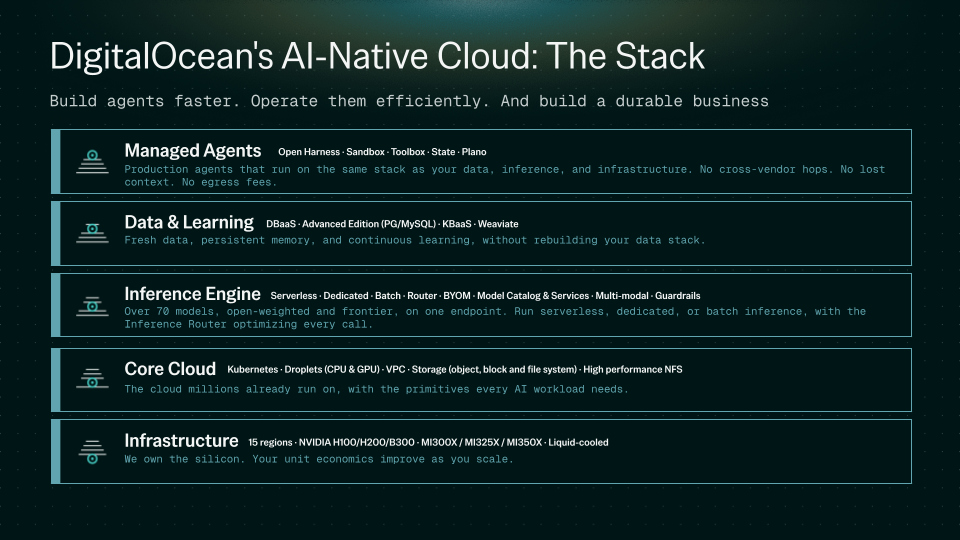
Deploy the new AI‑Native Cloud and enable the Inference Router to automatically route requests to the most cost‑effective model.
Patch: integrate vibevoice.cpp into LocalAI, test TTS/ASR pipelines on target hardware, and benchmark CUDA vs CPU performance.
Patch your LLM‑powered app to use a precomputed ruleset for model selection; schedule a cron to refresh pricing data from OpenRouter and expose a Deep Analysis button for ambiguous cases.
We use cookies so the comment feature on this site works. Read more