AI Design Principles: The Human‑AI Decision Contract and Automation Bias
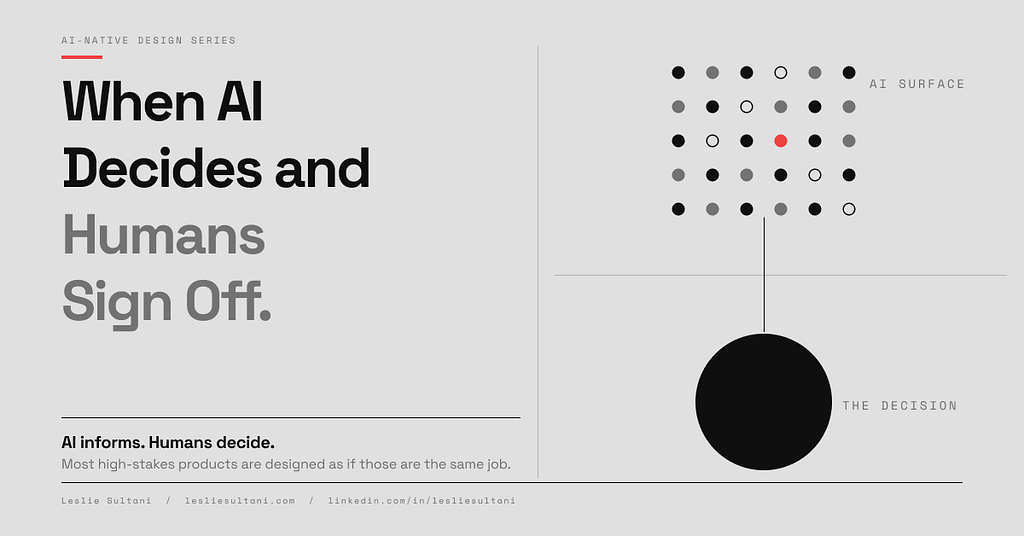
Review AI‑powered interfaces to ensure humans actively evaluate evidence, not just approve AI outputs.
Patch current AI workflows to require human evaluation of evidence before approval, and remove passive approval buttons.
Summary
AI products in high‑stakes domains often violate the core contract that AI is decision support and humans are decision makers. The design flaw is that interfaces present authoritative recommendations, causing users to defer to the AI under time pressure—a phenomenon known as automation bias. A 2023 JAMA study with 457 clinicians found that AI predictions improved diagnostic accuracy by 4.4 percentage points, yet when the model was biased the accuracy dropped, and saliency‑map explanations did not mitigate the bias. Adding a human reviewer actually increased the rate of following the AI’s recommendation, giving users a false sense of cover. Experiments that forced users to commit to a view before seeing the AI’s output reduced reliance on incorrect AI, but users disliked the friction. Legal, healthcare, autonomous vehicle, and criminal‑justice cases illustrate the real‑world costs of this design gap, from sanctions for fabricated court opinions to Tesla’s partial liability for an Autopilot crash. The article argues that product teams must design interfaces that keep humans actively evaluating evidence, not merely approving it.
The key takeaways are that automation bias is a pervasive risk, explanations alone are insufficient, and human reviewers can unintentionally reinforce AI errors. The article calls for a redesign of AI‑assisted workflows that foreground human judgment.
This analysis is relevant for internal teams developing AI‑enabled WordPress plugins and e‑commerce tools, where the human‑AI decision contract can impact user trust and legal compliance.
Key changes
- Automation bias causes overreliance on AI recommendations
- JAMA study shows 4.4% accuracy gain with AI predictions but bias can reverse it
- Saliency‑map explanations do not reduce bias
- Human reviewers increase following of AI, providing cover