AI Agents Surge: Codex, PrismML, and New Models Drive Innovation
Evaluate the new compressed models for deployment in your agent pipelines.
Evaluate the new compressed models for deployment in your agent pipelines.
Summary
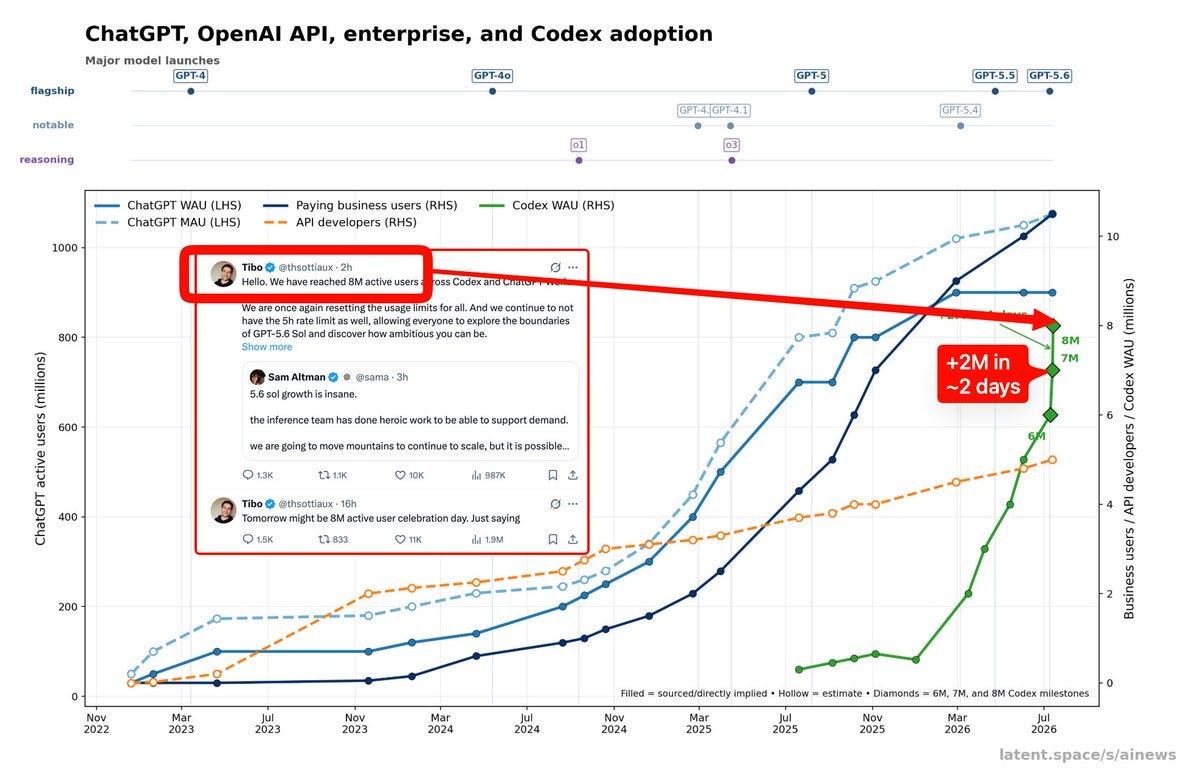
OpenAI’s Codex agent saw a 2.5‑fold increase in usage over a single week, a spike that prompted JetBrains to make Codex the default agent for its IDEs and led OpenAI to launch a new command‑line evaluation tool powered entirely by GPT‑5.6. The rapid uptake of the agent sparked a wave of tooling and observability improvements across the ecosystem. LangChain added tracing for Codex and later extended support to other agents such as Cursor, Copilot, Pi, and OpenCode, while Teknium’s Hermes released parallel tool‑call support and banked resets to cut latency.
Edge‑compression breakthroughs dominated the week’s headlines. PrismML unveiled Bonsai 27B in two ultra‑compressed formats: a ternary version at 5.9 GB (1.71 bits) and a 1‑bit version at 3.9 GB (1.125 bits), both released under Apache 2.0. These models demonstrated multimodal, tool‑using workflows on an RTX 5090 GPU and even on smartphones. Tencent Hunyuan followed with a 295 B Hy3 model that can run on a single GPU via llama.cpp with MTP, pushing the limits of on‑device inference. Quantization continued to advance, with NVFP4 dynamic quants applied to Gemma‑4, Qwen3.5‑122B‑A10B, and GLM‑4.7‑Flash, further reducing model size without sacrificing performance.
New agents and benchmarks also made headlines. OpenMOSS introduced MOSS‑VL‑Realtime, an 11 B vision‑language family with a 256 K context window that can watch and generate simultaneously. OmniAgent, built on Qwen2.5‑Omni‑7B, achieved a 50.5 score on LVBench using an Observation–Thought–Action loop that consumes only 203 frames compared to 768 for larger models. Perplexity’s WANDR benchmark expanded to 500 tasks and 170 k source‑backed records, while Agent Arena reported an 89 % reduction in system cost while maintaining accuracy. Together, these developments signal a shift toward harness‑centric agent design, compressed multimodal inference, and more realistic evaluation pipelines that bring AI agents closer to practical, real‑world deployment.
Key changes
- PrismML released Bonsai 27B, a Qwen 3.6 27B model compressed to 5.9 GB ternary and 3.9 GB 1‑bit variants under Apache 2.0.
- Tencent Hunyuan launched Hy3, a 295 B flagship‑scale model available in 1‑bit and 4‑bit formats that can run on a single GPU via llama.cpp with MTP.
- Daniel Hanchen announced NVFP4 dynamic quantization for the Gemma‑4 family, Qwen3.5‑122B‑A10B, and GLM‑4.7‑Flash, enabling low‑bit inference on large models.
- OpenMOSS introduced MOSS‑VL‑Realtime, an 11 B vision‑language model with 256 K context that can keep watching while generating and interrupt answers in real time.
- OmniAgent 7B, built on Qwen2.5‑Omni‑7B, uses an Observation‑Thought‑Action loop to request only needed frames, scoring 50.5 on LVBench with ~203 frames versus 768 for competitors.
- LingBot‑World 2.0 released hour‑scale, 720p/60 fps interactive generation, the first open release with such real‑time video response.
- Perplexity’s WANDR benchmark contains 500 tasks and 170,495 source‑backed records, re‑fetching cited pages to evaluate dynamic web research claims.
- The article also notes PrismML’s demo of Hermes running Bonsai on an RTX 5090 and Locally AI’s phone deployment demo.