Codex Surges to 7 M Users, Prime Intellect Unveils New Verifiers and Open‑Model Optimisations
Patch your integration to handle GPT‑5.6's new model ladder and reset usage limits.
Migrate your OpenAI integration to GPT‑5.6 and adjust for the new model ladder and usage reset limits.
Summary
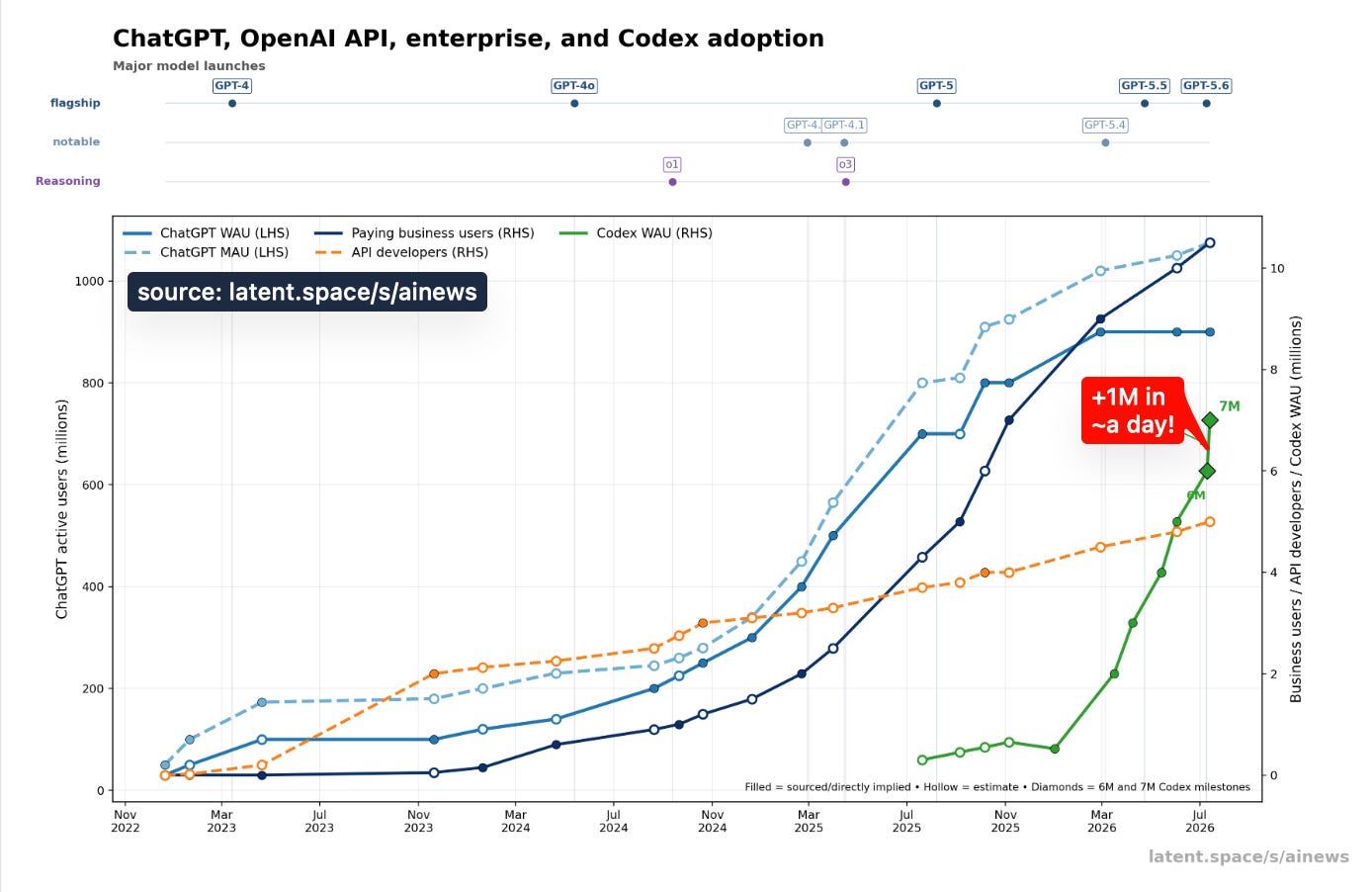
OpenAI’s Codex has experienced a dramatic rise in adoption, with the platform’s user base expanding to more than 7 million in the last six months and an additional one million users signing up in the past day alone. The growth, which represents a more than ten‑fold increase, has prompted analysts to ask whether Codex has surpassed its rival Claude Code in market share. While definitive usage statistics for Claude are not publicly available, the sheer scale of Codex’s uptake signals a significant shift in developer preference toward OpenAI’s code‑generation tools.
In parallel, Prime Intellect has released verifiers v1, a comprehensive redesign that separates environments into taskset, harness, and runtime layers. The new system stores rollout traces as message directed‑acyclic graphs (DAGs), cutting trace storage complexity from quadratic to linear in the number of steps. This architecture enabled the training of a 100‑billion‑parameter reasoning model on 40‑turn software engineering tasks, completing 1,000 reinforcement‑learning steps across six H200 nodes in under two days. Integration with vLLM guarantees exact token identifiers and log‑probabilities for every rollout path, improving reproducibility and debugging.
OpenAI’s latest updates address the high‑cost usage of GPT‑5.6 Sol. The company rolled back the context limit from 372 k to 272 k tokens, added inference optimisations that boost usage by roughly ten percent, and corrected over‑active multi‑agent behaviour at elevated settings. The ChatGPT Work desktop app now merges Codex and ChatGPT functionality, and OpenAI has opened Build Week submissions while extending ChatGPT to WhatsApp in the European Economic Area. On the open‑model front, Hugging Face Transformers can now run natively in vLLM, eliminating duplicate implementation work, and a new quantisation technique outperforms NVIDIA’s ModelOpt by discovering superior layer‑wise precision.
Collectively, these developments underscore an industry pivot toward harness‑centric agent design, cost‑per‑task optimisation, and more efficient inference pipelines. The message‑DAG trace format and reduced storage complexity make long‑horizon multimodal rollouts and router replay far more practical, signalling a broader focus on infrastructure scalability, transparent cost controls, and open‑model performance parity.
Key changes
- OpenAI launched GPT‑5.6 on July 9, attracting 6 M users in the first 48 hours and 7 M users 24.5 hours later.
- Prime Intellect released verifiers v1, redesigning its environment stack into taskset, harness, and runtime, and storing rollout traces as message DAGs to reduce O(n²) growth to O(n).
- Verifiers v1 achieved a 100 B reasoning model trained on 40‑turn SWE agent tasks, 1000 RL steps, on 6 H200 nodes in under 2 days.
- OpenAI performed multiple usage‑limit resets to address the higher cost of GPT‑5.6 and to keep users from being nudged toward expensive settings.
- Claude Code’s user base grew from ~550‑700 k at Jan 1 to roughly 10 × higher in six months, reaching about 10 M weekly active users.
- The article also reports that Codex usage increased by 1 M users since the last update, and that the bulk of coding has moved to Claude Tag.