DigitalOcean Deploy 2026: Unified AI Inference Stack with Serverless, Dedicated GPUs, and Intelligent Routing
Migrate your OpenAI‑compatible code to DigitalOcean serverless inference, run the break‑even calculator for your model, and enable the Intelligent Router to auto‑select cheaper models for non‑critical tasks.
Migrate your current LLM workloads to DigitalOcean serverless inference, use the break‑even calculator to determine when to switch to dedicated GPUs, and enable the Intelligent Router to automatically pick cheaper models for non‑frontier tasks.
Summary
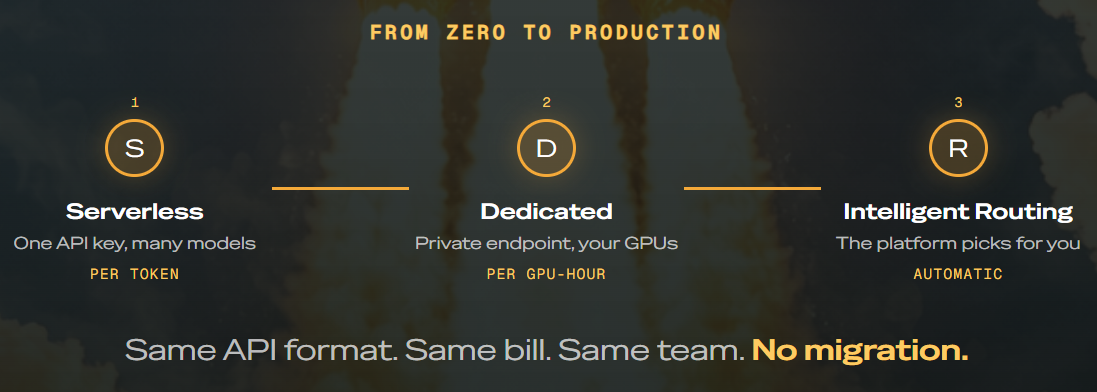
DigitalOcean unveiled its Deploy 2026 platform, offering a unified AI inference stack that spans serverless, dedicated GPU, and intelligent routing modes. The serverless tier provides a single API key, 50+ OpenAI‑compatible models—including proprietary GPT‑5.2 and Claude Opus 4.7—and per‑token billing from $0.05 to $25 per million tokens, while built‑in MCP tools let developers connect to DigitalOcean services without code.
Dedicated inference gives private endpoints, hourly pricing (e.g., AMD MI300X at $1.99/hr), and a two‑line code switch from serverless, with a GPU fleet that includes AMD MI300X/MI350X and NVIDIA H100/H200/B300. The platform’s Intelligent Router automatically selects the most cost‑effective model per request, cutting a demo cost from $0.00556 to $0.00019 (97 % cheaper) and reducing latency from 3.9 s to 3.3 s. A break‑even calculator shows that Claude Opus 4.7 at $5/million tokens versus an MI300X at $1.99/hr reaches 234 requests per hour, guiding when to move from serverless to dedicated. The session demonstrated a router built in the console in two minutes that cut costs by ~80 % across a batch of eight support tickets, all without rewriting code or renegotiating contracts. DigitalOcean’s ownership of GPUs, networks, and data centers promises lower cloud bills and faster workloads as hardware improves. The new inference stack positions teams to scale AI workloads from prototype to production on a single platform.
Key changes
- DigitalOcean introduces serverless inference with one API key, 50+ models, OpenAI‑compatible endpoints, and per‑token billing from $0.05 to $25 per million tokens
- Proprietary models GPT‑5.2 and Claude Opus 4.7, plus open‑weight models Llama 4, Mistral, and DeepSeek are available on the same platform
- Built‑in MCP tools enable zero‑code integration with DigitalOcean services, knowledge bases, and third‑party APIs
- Dedicated GPU inference offers private endpoints, hourly pricing (e.g., AMD MI300X $1.99/hr), and only two lines of code to switch from serverless
- GPU fleet includes AMD MI300X/MI350X and NVIDIA H100/H200/B300 for training and inference
- Break‑even calculator shows Claude Opus 4.7 at $5/million tokens vs MI300X $1.99/hr breaks at ~234 requests per hour
- Intelligent Router automatically selects the optimal model per request, reducing cost 97 % and latency from 3.9 s to 3.3 s in demo
- Router can be built in the console in two minutes, cutting costs by ~80 % across a batch of eight support tickets