Meta‑Harnesses Landscape: Omnigent and the Rise of Agent Infrastructure
Integrate Omnigent into your agent stack to standardize session APIs and enforce spend controls.
Integrate Omnigent and set up session APIs, configure spend controls, and test agent collaboration.
Summary
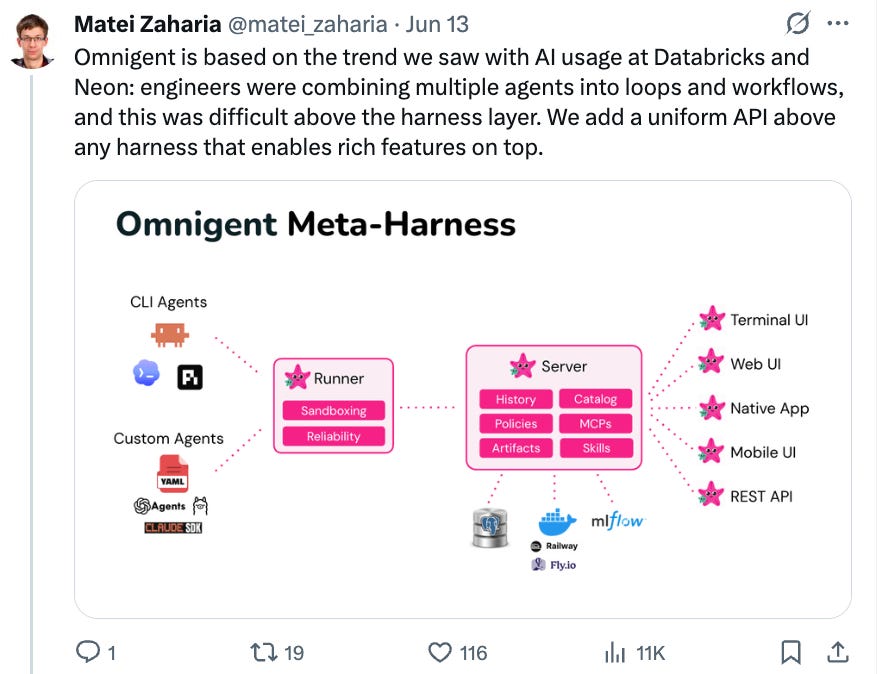
The article traces the evolution of meta‑harnesses from early players like Conductor and Zed’s ACP to newer entrants such as OpenInspect, Cloudflare Flue, Vercel Eve, HarnessAgent, and Heypi. Databricks’ CTO Matei Zaharia has positioned Omnigent as a pluggable, open‑source architecture that pulls any coding or knowledge work agent into a standardized, secure, and scalable system. Omnigent provides a common API for agent sessions, files, streams, tool calls, and cancellation, addressing portability, collaboration, session history, security, and spend controls. The discussion emphasizes the need for a unified infrastructure that supports both coding agents and custom enterprise agents, highlighting the importance of persistent sessions, cloud sandboxes, and collaborative search. Databricks’ rapid prototyping culture and scale reinforce the viability of an open‑source meta‑harness in the AI ecosystem.
Key changes
- Conductor and Zed’s ACP pioneered early meta‑harnesses
- OpenInspect, Cloudflare Flue, Vercel Eve, HarnessAgent, and Heypi followed as subsequent players
- Omnigent offers a common API for agent sessions, files, streams, tool calls, and cancellation
- Architecture addresses portability, collaboration, session history, security, and spend controls
- Supports both coding agents and custom enterprise agents
- Emphasizes persistent sessions, cloud sandboxes, and collaborative search
- Databricks’ rapid prototyping culture and scale validate the approach
- Open‑source nature encourages community adoption