OpenAI Model Disproves Erdős Unit Distance Conjecture
Integrate GPT‑5.6 into your reasoning pipelines to tackle complex math problems.
Integrate GPT‑5.6 into your reasoning pipelines to tackle complex math problems.
Summary
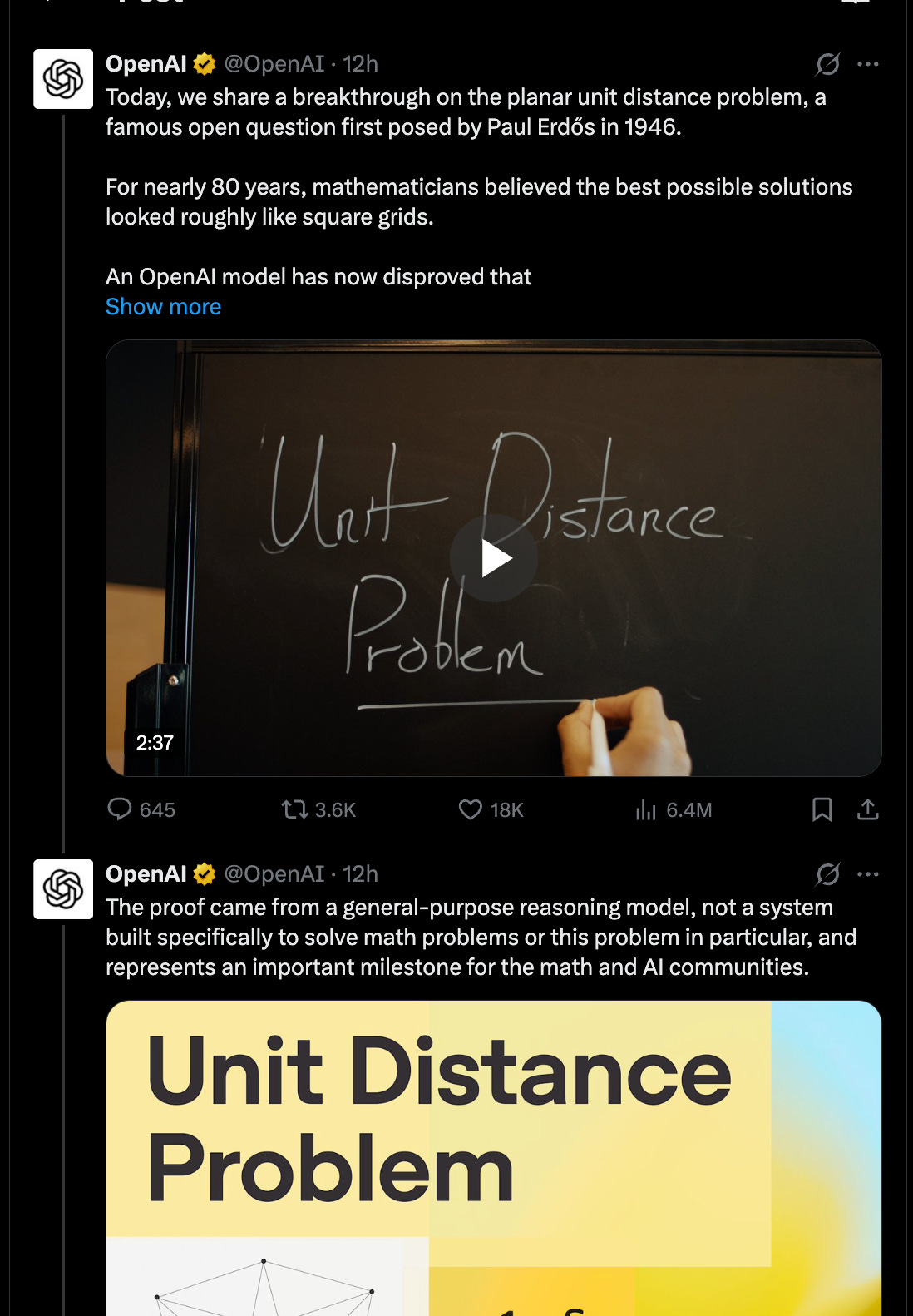
An internal OpenAI model has autonomously solved a long‑standing problem in discrete geometry, disproving Paul Erdős’s conjecture that the maximum number of unit‑distance pairs among \(n\) points in the plane grows no faster than \(n^{1+o(1)}\). The breakthrough, announced by the company, shows the model constructed infinite families of point sets that contain at least \(n^{1+\delta}\) unit‑distance pairs, where \(\delta>0\) and has been refined to 0.014. This polynomial improvement over the classic square‑grid construction replaces the Gaussian integer approach with richer algebraic structures, employing tools from algebraic number theory such as infinite class field towers and Golod–Shafarevich theory.
The proof was independently verified by external mathematicians and accompanied by a companion paper that explains the argument and its significance. It marks the first time an AI system has autonomously resolved a longstanding open problem in combinatorial geometry, demonstrating the model’s capacity for original reasoning and complex proof generation. The work highlights AI’s potential to contribute to frontier mathematical research and offers a new approach to solving combinatorial geometry problems that have resisted human effort for decades.
Erdős’s conjecture, posed in the 1960s, has been a central challenge in discrete geometry, with many mathematicians attempting to find tighter bounds on the number of unit distances. The new result not only disproves the conjecture but also provides a constructive method for generating point configurations that exceed previous upper bounds. The discovery is expected to spur further research into AI‑assisted proof techniques and may lead to new insights in related fields such as graph theory and number theory.
The announcement has been met with enthusiasm from the mathematical community, who see it as a milestone in the collaboration between human and machine intelligence. While the model’s internal workings remain proprietary, the verification process and the published companion paper provide transparency and a framework for future AI‑driven discoveries. The implications extend beyond pure mathematics, suggesting that AI could play a pivotal role in tackling other complex, unsolved problems across science and engineering.
Key changes
- GPT‑5.6 disproved the planar unit distance problem with a new construction
- Model ran <32 h and cost <$1 000
- General‑purpose reasoning model, not domain‑specific
- Tim Gowers praised the result as a clear AI solution to an open problem
- Hongxun Wu highlighted the reasoning milestone
- Model outperforms previous LLMs on complex logical tasks
- Validation by mathematicians adds credibility
- Potential to generalize to other math domains