OpenAI launches GPT‑5.6 family with Sol, Terra, Luna and new agent features
Patch your API integration to use GPT‑5.6 Sol/Terra/Luna model IDs and adjust cost calculations to the new pricing tiers.
Get 5 things to act on each day — instead of 1,500 articles to read. Free, Builder, or Pro.
Patch your API integration to use GPT‑5.6 Sol/Terra/Luna model IDs and adjust cost calculations to the new pricing tiers.
Patch your integration to handle GPT‑5.6's new model ladder and reset usage limits.
Leverage Meta's Muse Image model to generate Instagram content directly from public posts and reels.
Update usage plans to reflect extended Fable 5 access until July 19 and OpenAI’s removal of the 5‑hour limit for Plus, Business, and Pro plans.
Enable GPT‑Live voice mode in the ChatGPT app, monitor for laugh bugs, and ensure background delegation to GPT‑5.5 is active.
Install llm-meta-ai, set the Meta API key, and run `llm -m meta-ai/muse-spark-1.1` to generate SVGs or test the new API.
Integrate RxBrain 6.2B multimodal foundation model for embodied cognition into your applications to enable joint subgoal planning and world‑state prediction.
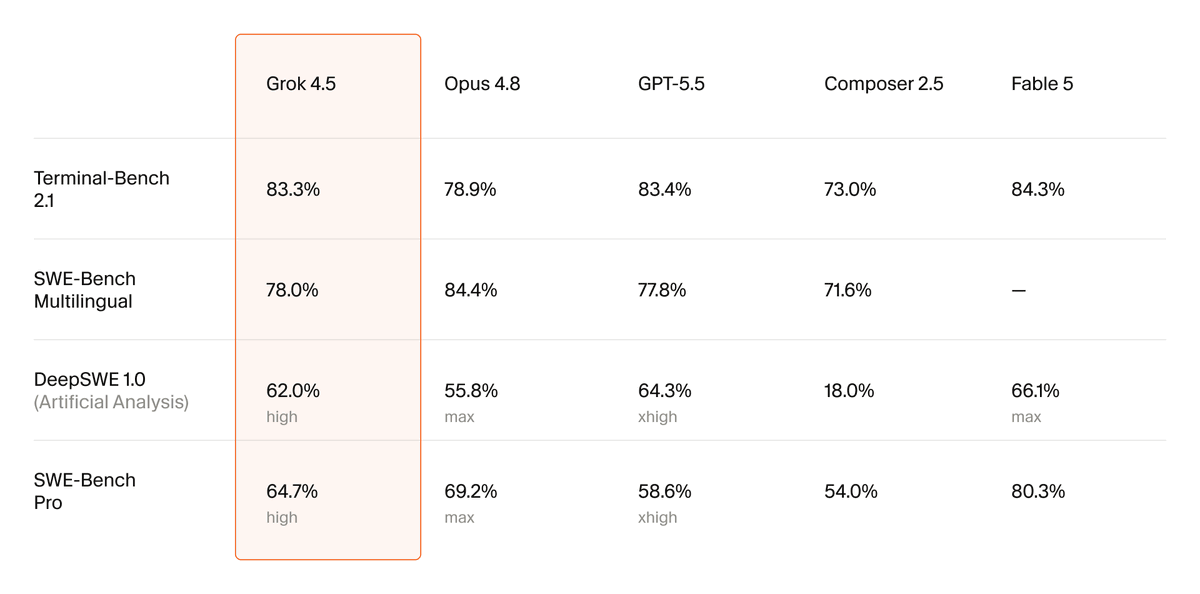
Update your integration to use Grok 4.5 and adjust cost calculations to the new pricing.
Integrate ExLlamaV3 v1.0.0 into your inference pipeline to leverage its new attention kernels, tensor‑parallel support, and performance boosts.
Deploy Qwen 3.5 122B Heretic ROCmFP4 iMatrix with 122B total, 10B active, 60.70 GiB memory, 28.45 tok/s for high‑throughput inference.
Integrate Bonsai 27B 1‑bit quantized model into your local inference pipeline using custom WebGPU kernels.
Apply the SYCL PRs to your llama.cpp build to improve Intel GPU inference speed and kernel compatibility.
Test the new ternary Qwen3.6 27B on your workloads to evaluate memory savings and performance gains.
Benchmark DeepSeek V4 flash on your 4x RTX PRO 6000s or 8 Blackwells to determine suitability for 20 concurrent users.
Execute the DeepSeek V4 one‑shot demo to gauge its code generation speed for hybrid game environments.
Deploy the GPT‑5.5‑Cyber model to enhance vulnerability detection across large codebases.
Test GPT‑5.5‑Cyber’s patch generation on your codebases to assess coverage and automation.
Deploy Krea 2 Raw for high‑fidelity work or Krea 2 Turbo for fast, 2K rendering, load LoRAs via Hugging Face, and test prompt‑fidelity and speed in your pipelines.
Integrate GLM‑5.2 into your coding harness and benchmark against existing models.
Add DomainShuttle to your video generation pipeline to leverage Domain‑MoT, AdaLN, DualRoPE, and Cross‑Pair Consistent Loss for domain‑aware subject modeling.
Re‑implement the nine‑skill Claude Code pipeline, saving each step to a file, so drafts can read the original article, style guide, and research, reducing hallucinations and improving editorial consistency.
Patch your systems to handle potential AI‑driven vulnerability discovery and restrict Anthropic Fable access in regulated environments.
Patch your inference pipelines to use the new Gemma 4 Balanced QAT models with MTP for 35‑53% speedup, ensuring you use Q4_K_M quantization and mmproj for vision.
Review your LLM budget and evaluate open‑weight alternatives such as DeepSeek V4 or Allen AI’s OLMO for cost‑effective inference.
Integrate Nemotron‑TwoTower‑30B‑A3B‑Base‑BF16 into your inference pipeline and benchmark against autoregressive baseline.
Use GPT‑5 Pro for hypothesis generation and experiment simulation in your research pipeline, while applying the Preparedness Framework.
Patch your AI guardrails to block Fable 5 jailbreak attempts and enforce strict prompt filtering.
Update your Claude integration to the 4.8 endpoint and enable Dynamic Workflows for long‑horizon tasks.
Update your Gemini API integration to use the new Gemini 3.5 Flash endpoint and enable Omni Flash for video generation.
Test mid‑conversation system messages and the new 1,024‑token prompt cache minimum; update your SDK to the latest commit and adjust caching logic accordingly.
We use cookies so the comment feature on this site works. Read more