Can I run a 27B model on an RTX 3060 12GB GPU?
Use quantization or offloading to fit 27b on 12GB GPU.
Get 5 things to act on each day — instead of 1,500 articles to read. Free, Builder, or Pro.
Use quantization or offloading to fit 27b on 12GB GPU.
Test PP speed on a dual RTX 6000 setup for your target model.
Keep using 1080 Ti for small models but plan an upgrade if context exceeds 4k tokens.
Deploy the new useknockout v0.6.0 FastAPI service to Modal or run the Docker image locally, and integrate the MIT‑licensed SDKs for Node, React, CLI, or Python.
Adopt plan‑and‑review workflows by defining system specs in natural language and using AI to scaffold, then scrutinize thoroughly.
Download the EnterpriseRAG‑Bench repo, run the evaluation harness against your RAG system, and compare results to the baseline leaderboard.
Deploy ChatGPT/Codex-based assistant to cut meeting prep from 20 minutes to under 1 minute.
Download the Qwen3.6‑35B‑A3B‑MTP‑GGUF model from HuggingFace, run benchmarks on your GPU, and compare the modest 6 % (Q4) and 2.5 % (Q8) speed gains to the 27B variant before deciding on deployment.
Use a framework that supports Gemma‑4 MTP, such as llama.cpp or vLLM, instead of MLX.
Use Gemma‑4's built‑in PDF parsing for multi‑modal PDF tasks instead of feeding PDFs to llama.cpp, which treats them as text or images.
Explore ProgramBench to benchmark your LMs on end‑to‑end program synthesis; evaluate against 200 tasks covering CLI tools, FFmpeg, SQLite, PHP, and note that current models only achieve 95 % pass on 3 % of tasks.
Benchmark GLM's plan mode and tool calling; it achieves 69% plan_mode success, 71% plan_mode_stress, 90% tool_calling, 67% file_generation, and 75% combined, lower than Qwen3-coder-next.
Deploy Atlas via Docker to serve Qwen3.6-35B-A3B-FP8 with speculative decoding and prefix caching.
Patch your monitoring to capture AI Overviews and AI Mode traffic patterns, as they may affect click‑through and ranking signals.
Implement a governance framework that tracks agent usage, token costs, and learning outcomes to ensure AI adoption delivers measurable organizational value.
Review RDMA zero‑copy GPU memory sharing on macOS to evaluate inference performance.
Observe that frontier firms use 3.5x more AI per worker and 16x more Codex messages; consider measuring depth and agentic workflows in your organization.
Check SSD capacity before downloading more models.
Benchmark LLMs with realistic context sizes, multimodal workloads, hardware specs, and parallel processing to reflect real-world performance.
Attend Interrupt 2026 to learn about enterprise agent scaling, multi‑agent architectures, and LangSmith observability and evals.
Implement agentic engineering concepts in your workflow.
Explore multi‑GPU scaling options and evaluate VRAM expansion feasibility.
Run llama‑server with the provided command line to benchmark a 3090 at 50 t/s using 100 k context, MTP, and flash‑attn.
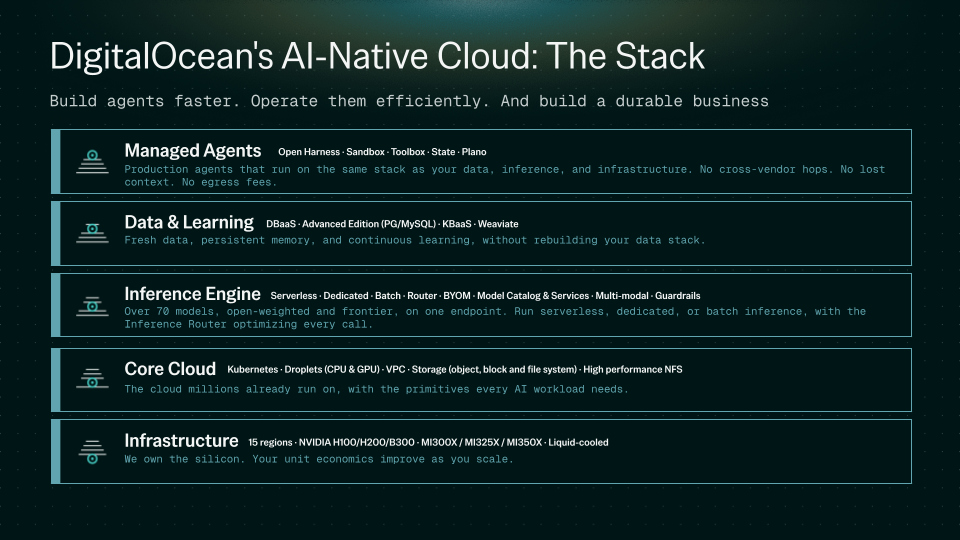
Observe the new AI‑Native Cloud and its inference router to reduce cost and latency in production AI workloads.
Explore the new Gemini Enterprise Agent Platform API and demo code on GitHub to experiment with agent building.
Track AI visibility by auditing crawlability, monitoring AI share of voice, and using Semrush AI Visibility Toolkit to capture mentions, citations, and sentiment, then correlate with conversions.
Clone the agent‑sh repo, install the overlay‑agent and terminal‑buffer extensions, and experiment with local or cloud models to embed an AI agent in your shell.
Run the provided llama.cpp command with the Qwen3.6-35B-A3B-UD-Q5_K_XL model to generate a full website and Playwright tests in one go.
Benchmark your own prompt processing times and adjust caching or model selection to reduce prefill latency.
Verify that passing both speculative decode and ngram flags results in only ngram being active; if you need both, modify the code or wait for a future patch.
We use cookies so the comment feature on this site works. Read more