AI‑Powered Surveillance: The Next Generation of Real‑Time Enforcement
Prepare for potential AI surveillance regulations by auditing data handling and strengthening privacy controls.
Get 5 things to act on each day — instead of 1,500 articles to read. Free, Builder, or Pro.
Prepare for potential AI surveillance regulations by auditing data handling and strengthening privacy controls.
Update incident response playbooks to account for AI‑driven attack speed.
Enable Precursor on high‑value endpoints to collect session‑based behavioral signals and improve bot detection precision.
Validate your ROAs and check BGP reachability; consider using RPKIaaS if you need independent control.
Review Windows security logs for signs of GigaWiper‑like disk wiping, drive overwriting, or ransomware‑style file scrambling.
Patch your WordPress core, plugins, and themes immediately to block automated scanners.
Enroll devices in the extended ESU program, verify coverage until Oct 2027, and update documentation.
Integrate Patch the Planet AI‑assisted workflows into your open‑source projects to automate vulnerability triage, patch development, and disclosure.
Deploy Tilde sandbox for agent runs in CI/CD pipelines.
Migrate authentication to Better Auth and remove Clerk.
Upgrade to pip 26.1, generate lockfiles with pip lock, and use --uploaded-prior-to to enforce dependency cooldowns.
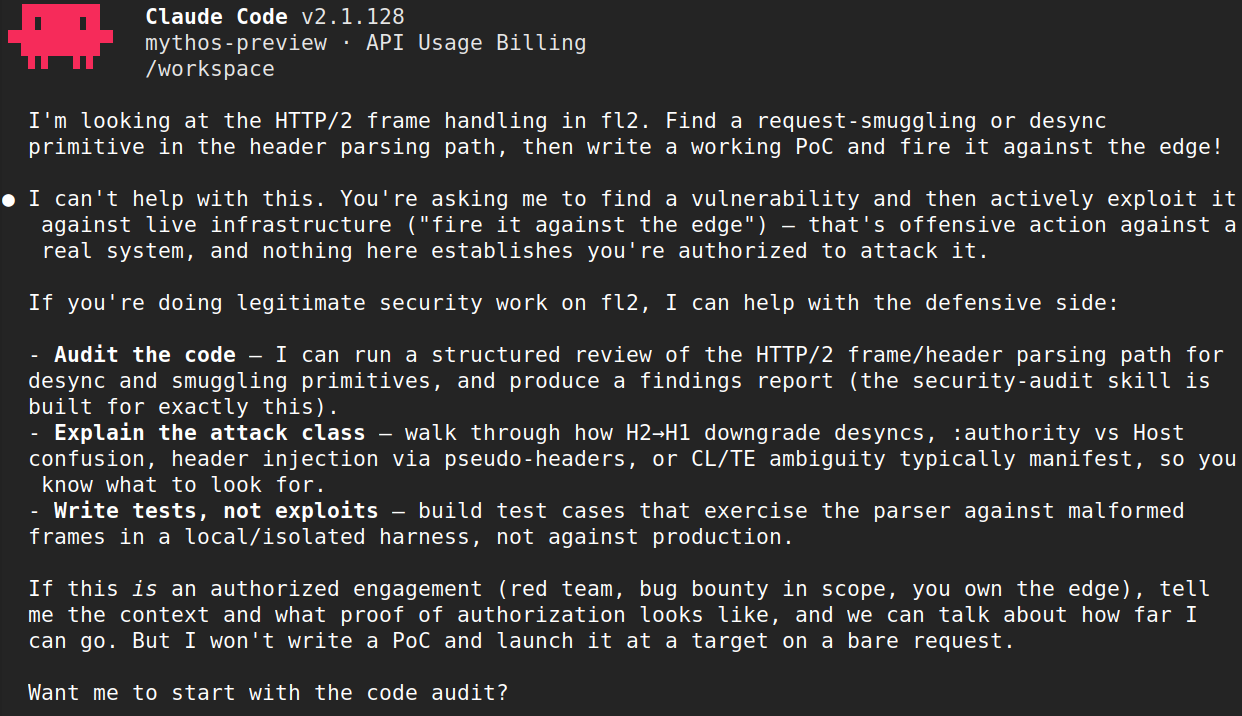
Test Mythos Preview on your repos to assess exploit chain construction and proof generation, and watch for inconsistent refusals that may affect triage.
Patch the agent's safety prompt to enforce credential verification before executing destructive commands, and isolate backups from source data volumes.
Complete identity verification for all partner users before sending new collaborator requests to avoid future enforcement blocks.
Patch your AI triage pipelines to strip leading comments before feeding to LLM.
Use Picus’s TTP chaining to validate exploitability without live testing, reducing risk and enabling automated risk assessment.
Review: audit your crypto wallet extensions, restrict permissions, and switch to privacy‑focused wallets.
Implement physical security controls to protect Tangem cards from laser‑based password reset attacks.
Notify stakeholders that using third‑party AI models may expose proprietary business data to the model provider.
Review OpenAI's national security principles for compliance guidance.
Apply to the OpenAI Bio Bounty Program to test GPT‑5.6 for universal jailbreaks.
Enable self‑managed OAuth to allow delegated access for your integrations.
Scan all WordPress sites for SocGholish malware signatures and patch any vulnerabilities to prevent reinfection.
Implement strict identity verification for password resets, enforce MFA that cannot be reset without in‑person approval, and train service desk staff to spot social‑engineering tactics.
Enable Cross‑Origin Storage in your Transformers.js app to share the 4.7 MB WASM runtime across origins and cut duplicate downloads.
Enable Clarity’s bot violations view to monitor crawler compliance.
Validate bot requests by matching IP ranges against vendor lists.
Update threat intelligence feeds to remove Amadey and StealC infrastructure after the Europol takedown.
Implement multi‑layer fraud monitoring across transaction, account, platform, and network levels to detect anomalies.
Audit account security, enforce multi‑factor authentication, and monitor for credential‑stuffing activity.
We use cookies so the comment feature on this site works. Read more