Microsoft Unveils MDASH, a Multi‑Model AI System for Vulnerability Discovery
Enable the MDASH pilot for your environment and configure AI agents to match your vulnerability taxonomy.
Get 5 things to act on each day — instead of 1,500 articles to read. Free, Builder, or Pro.
Enable the MDASH pilot for your environment and configure AI agents to match your vulnerability taxonomy.
Test Daybreak integration in a sandbox to evaluate automated vulnerability detection and patch recommendations.
Test the 0GM-1.0-35B-A3B-0427 model on your inference pipeline to evaluate consistency improvements over Qwopus.
Deploy Claude agents at scale on AWS using IAM authentication, CloudTrail audit logging, and a single AWS invoice; enable Managed Agents, Advisor strategy, code execution, and other platform features.
Build an interaction model that processes 200 ms micro‑turns across audio, video, and text, delegating long‑horizon tasks to an asynchronous background model.
Patch your Realtime API integration to use GPT‑Realtime‑2 with 128K context, enable reasoning‑effort controls, and update tool‑call logic to support parallel calls and preambles.
Use Claude or GPT‑5.5 to generate or port systems‑language code, enabling rapid production of compilers and runtime libraries.
Run the Mythos scan report and verify the single confirmed vulnerability before the 8.21.0 release.
Add: install adamsreview plugin and configure it to use the Max plan for best performance.
Create a skill folder with SKILL.md, define trigger phrases, add examples, and test it in Claude to automate LinkedIn post generation.
Explore Sarvam‑30B and Sarvam‑105B MoE models for reasoning and coding tasks; evaluate performance on Indian languages.
Patch your OpenAI SDK to support GPT‑5.5 Instant and GPT‑5.5 Cyber, and update Codex goal flow to use /goal for long‑running tasks.
Publish the Qwen3.6‑35B‑A3B model with preserved MTP tensors and run the provided benchmark to confirm MTP preservation.
Use the new EMO model with 1B active/14B total trained on 1T tokens, leveraging document‑level routing for domain clustering.
Integrate Caliby via pip install caliby and replace your current vector DB for agent apps.
Deploy CyberSecQwen‑4B on a single 12 GB GPU to classify CWEs and answer CTI queries, achieving 97 % of the 8B baseline accuracy with half the parameters.
Deploy Claude 4.5+ models for production; they now have zero blackmail rate thanks to constitutional and OOD training.
Test EMO by loading only 12.5 % of its experts on your benchmark and compare the 3 % performance drop to the full model.
Z‑lab has released the DFlash‑enabled Gemma 4 26B A4B‑it model, offering faster speculative decoding and stateful KV cache for longer sessions.
Configure your site’s endpoints to return machine‑readable structured data and enable session persistence for agent runtimes.
Explore GuideAnts to build modular AI workspaces with local LLM, image, ASR, TTS, embeddings, and document intelligence; integrate via FastAPI and Hugging Face Hub.
Analyze token usage per prompt size and adjust billing thresholds to mitigate cost spikes.
Switch to STAMLite for training LLMs to reduce GPU usage by ~50% and improve stability with dynamic beta1.
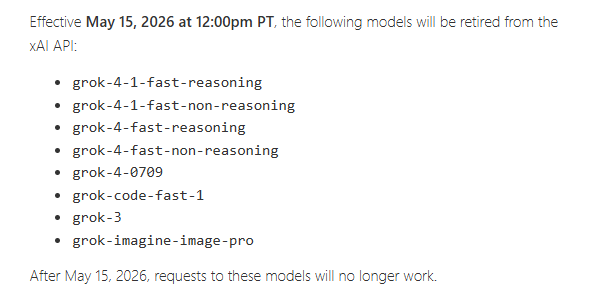
Notify clients about the impending Grok 4.1 Fast deprecation and advise migration to alternative models before May 15 2026.
Use the released NLA code to generate natural‑language explanations of Claude activations for safety audits.
Explore the new NLA weights for Gemma 3 27b instruct to visualize token‑level internal thoughts.
Adopt Codex as the primary coding agent to cut design time by 40% and development time by 70%.
Patch your security tooling to use GPT‑5.5 with Trusted Access for Cyber for most defensive tasks, and enable Advanced Account Security by June 1 2026 for any users who need GPT‑5.5‑Cyber access.
Integrate Parloa's AMP to allow business users to define agent behavior in natural language and test with GPT‑5.4 simulations.
Integrate the WebWorld 32B model from Hugging Face into your web‑agent training pipeline to achieve +9.9% MiniWob++ and +10.9% WebArena gains, and use it as a look‑ahead world model that outperforms GPT‑5.
We use cookies so the comment feature on this site works. Read more